Blip FAQ
What is Blip?
Welcome to Blip, our achievement hunting website. Whether you're a seasoned player or just beginning your gaming journey, we're delighted to have you join our community. By utilizing Blip, you can effortlessly register your profiles from Xbox, PlayStation, Steam, and RetroAchievements, enabling you to conveniently track and manage your achievements across multiple platforms. With Blip, say goodbye to scattered progress and experience a streamlined approach to monitoring your gaming accomplishments. We're excited to have you on board as we embark on this achievement-filled adventure together!
But we're not just about tracking and showcasing achievements. Our community is a haven for like-minded gamers who share a passion for reaching new milestones and pushing their gaming limits. Engage and boost with fellow players, shares guides and walkthroughs, and compete for a spot on our site leaderboards. Track your milestones, unlocks, completion percentage, participate in events and show off your best accomplishments on your customized profile.
Welcome aboard, and let the achievements begin!
How Does Blip Scoring Work?
Blip Score is one of our community's unique scoring metrics for unlocking achievements. Blip Score acts to replace the existing scoring systems across the four platforms to make a more meaningful number. The calculation is rather simple, taking into account two factors: the unlock rate of the achievement, and your completion status of the game.
Blip Score is calculated as follows: Rarity Points x Multiplier.
Rarity Points: Rarity Points are the base scores of every achievement, and it is calculated using a simple formula:
RP = 1/(UR) - 1, where RP is the Rarity Points, and UR is the unlock rate as a decimal. For example, an achievement with a 25% unlock rate would be worth 1/(0.25) - 1 = 3 RP. This formula has this important property:
An achievement or trophy with a 100% unlock rate is worth zero.
Another way to think about this: if an achievement is unlocked by 1 out of over X users, it will be worth X-1 points. i.e. an achievement that is unlocked by one out of every seven players will be worth six.
The pool of players that the unlock rate depends on is not the entire player base for that game. In order to count towards a game's score calculations, you must have unlocked at least the average amount of unlocks for that game. This means that if you start a game, unlock one achievement, then never play it again, your lack of unlocks will not inflate the scores of other achievements.
Multiplier: Each game will have a multiplier value, which depends on your overall progress through the game. This multiplier will apply to every unlock in the game, so reaching a completion threshold will increase the scores of all of your previous unlocks. The multipliers work as follows:
If you have less than 25% of the unlocks, your multiplier is x1.
If you have 25%-49.99% of the unlocks, your multiplier is x2.
If you have 50%-74.99% of the unlocks, your multiplier is x4.
If you have 75%-99.99% of the unlocks, your multiplier is x8.
If you have 100% of the unlocks, your multiplier is x16.
This means that upon earning the final unlock in a game, your overall score for that game will at least double as the multiplier jumps from x8 to x16. This will help incentivize cleaning up those last few annoying achievements in your games. Unobtainable achievements will not count towards the multiplier, meaning you can still reach a 16x multiplier without unlocking them.
Existing scoring systems, such as Xbox Gamerscore, or PlayStation trophy tiers incentivize targeting easy achievements to maximize your score, and not bothering with the difficult ones. By zeroing the gimme unlocks and offering multipliers, we are incentivizing more difficult achievements, as well as full completions.
What is Blip's Cheat Policy?
Methods of cheating your achievements exist on all four ecosystems that we track on Blip. Naturally, we don't want users who abuse these methods to dominate our leaderboards, and we have developed this cheat policy as a means of keeping competition fair on Blip.
What is Cheating:
- The use of an external program/editor to modify a game save or to directly unlock achievements.
- The use of a second profile glitch (SPG) to reallocate game save ownership to a new account.
- The use of trainers or mods, with the following exceptions:
- Games that explicitly allow mods, such as Surviving Mars for Xbox. We, under no circumstances, will punish a player for playing a game in a way that the developers deem okay. That isn't fair to anyone.
- The use of traded modified items of worlds. If you aren't the one doing the modding, then you need not worry. The basis for this rule is that we do not police people, we police accounts, so if someone makes a modded item or world that is within the bounds of what the vanilla game will allow, such that a player can use it without installing mods themselves, then a player could simply create the mod on a dummy profile to bypass the rule of no modding. Because of this, we will not police the trading of modded weapons, such as those in Borderlands, or the creation and distribution of modded worlds in Minecraft, etc.
What isn't Cheating?
- Boosting, glitch abuse, scripts or turbo controllers, and console commands. Just because it isn't the intended way of getting the achievement, doesn't mean it's off limits. So long as your are not using any sort of external editing software, everything is fair game. However, developers may impose their own bans for boosting, or the use of macros/turbo controllers in multiplayer play. While this doesn't violate our cheat policy, you are at the mercy of game developers when using these methods in online play.
- Date manipulation or degrading. Playing older, unpatched version of games offline, then syncing the achievements online is 100% allowed. Similarly, going offline and setting your date or time to something else to unlock an achievement is perfectly acceptable.
- The use of LAN servers. What means are used to host a server are not a concern of ours. This means that server hosting through programs such as Project Cartographer are allowed.
What is the Reporting Process for Cheating?
If a player is suspected of cheating, the policy enforcement team will notify the player of the exact games and achievements that they are suspected of cheating, as well as why they believe them to be cheated (impossible timestamps, out-of-order unlocks, unlocked unobtainables, etc.). There are two different levels that a report may be:
- Level One Report: Sometimes, when an account is investigated, it is blatantly obvious that cheating occurred. This could be the case if someone unlocks unobtainable achievements, online-only achievements offline, or numerous unrelated achievements with impossibly close timestamps (telltale sign of game-saving). This would be a "level one" report, and the policy enforcement team would give the player their punishment outright upon sending them their findings. A report will only be a level one report if they are undeniably guilty, though this is the overwhelming majority of cases.
- Level Two Report: In the event that a player is suspected of cheating, though it isn't blatantly obvious (perhaps trainers are suspected, speed of completion is questionable, etc.), the report will be elevated to "level two". The policy enforcement team will contact the player in question regarding the achievements, though the punishments will not be handed out initially. The player will have seven days to respond and can engage back and forth with the policy enforcement team through private messages, where they can plead guilty/innocent and explain themselves. If no response comes in for seven days, they will be treated as guilty and have their leaderboard privileges reduced temporarily, though the case will remain open. The tried player can appeal at any time and engage with the policy enforcement team if they are innocent.
What are the Punishments for Cheating?
- Three Games: Three is the magic number. If you cheat three or more games on one ecosystem after joining the site, you will no longer have leaderboard privileges for that ecosystem, nor will you have the right to participate in site events involving that ecosystem. You will not receive a warning if three or more games are cheated, and all games on that ecosystem will receive scaled scores of 0.00. If you have less than three games cheated, the cheated games will receive scaled scores of 0.00, and will not count towards your completed games or achievement totals. They also will not count against your completion percentage, so a 100% completion percentage with cheated games removed is possible.
- First Report: If you cheat one of two games, your first report is treated as a warning. Regardless of what the severity of the reprt is, whether it be one single achievement, or two full games, additional cheating after the date of the first report being filed will not be tolerated. You will lose leadership privileges if you continue to cheat. If you cheat one game, get caught, then cheat one more, you will receive the same punishment as someone who gets caught having cheated three games.
- Separate Ecosystems: If you repeatedly cheat on one ecosystem, you will no longer appear on leaderboards for that ecosystem. That means that if you lose leaderboard privileges for Xbox, you can still complete for PlayStation, Steam, and RetroAchievements. You also will still show up on the universal leaderboards, though your stats for the cheated ecosystem will not be counted. In short, cheating on an ecosystem means you will no longer appear on leaderboards that are strictly that ecosystem, and your statistics for that ecosystem will be subtracted from all other leaderboards. Additionally, all ecosystems are acted on separately, thus if you cheat a game on Steam after receiving a warning for PlayStation, you will get a warning for Steam, not a punishment for a second report.
- New Profiles: If you lose leaderboard privileges, the only way to get them back is to register a new profile for that ecosystem. At any point, you can unlink a profile for one ecosystem from your account and register a new one to it. Punishments are tied to gaming profiles, not the site profile, thus linking and relinking a cheated account will not undo the punishment. However, punishments are tracked per site profile, and if you register a new account to circumvent a loss of leaderboard privileges, then cheat on that one as well, you will be deemed not worth the efforts of the policy enforcement team going forward and will receive a permanent site-wide leaderboard ban for all profiles linked to your Blip account. If you'd like to continue to compete, you can register a new profile and new accounts for all ecosystems.
Any and all infractions against the cheat policy by players prior to joining the site will not be reflected with a loss of any privileges, though the cheated games will receive scaled Blip Scores of 0.00 for their account. This will preserve their completion percentage but the games will not count towards their leaderboard totals. The player will also not count towards the game’s statistics and score calculations.
SPGs (second profile glitches) are treated slightly differently, in that they have their own warning system. Because it is technically possible, albeit immeasurably rare, for an SPG to occur as a fluke due to hardware malfunction, we will give players the benefit of the doubt and not count an SPG as the one warning. We will still remove the game, but it will not count towards your three game maximum. An exception is made if you are clearly, intentionally using SPGs to do numerous common SPG games in succession. We will be lenient with SPGs, as it is possible for them to happen at no fault of the players, so in extreme cases, players could reasonably argue for a second non-warning SPG report (namely for cases on odd platforms, such as iOS or Android). Do keep in mind that SPGs are incredibly rarely done unintentionally, so don't think you can get away with numerous SPG warnings outside of very extreme circumstances.
Will my Reports be Private?
Report procedures will be kept entirely private, between only the player and the policy enforcement team, though other users could determine what games a player has had removed by finding any games with scaled scores of 0.00. While report procedures will never be made public, a report itself can be made public if the player makes false claims about the report in public forums/on their own profile (i.e. lying about the contents of the report, claiming that the punishment was unjust, etc.). This will be seen as defaming the policy enforcement team and the report will be made public as defense.
What if I am Worried About Accidentally Cheating?
You need not worry. With the incredibly rare exception of fluke SPGs, one cannot cheat by accident. It's a deliberate and involved process, and not one that an honest user needs to worry about. In the event that you unlock something in mysterious circumstances not seen by any other user, you might be questioned, but if you didn't cheat, and rather found a way to unlock it as you did, tell the policy enforcement team so and you will not be punished.
What do Blip's Achievement Flags Mean?
Below many of the achievements on Blip, you will see a group of icons like so:

These are achievement flags. They are used to easily identify what kind of achievement that particular achievement is. There are 42 unique achievement flags on Blip, and their meanings are as follows:

Offline: This can only be unlocked in game modes that do not require an online connection.
Click for example

Online: This can only be unlocked in game modes that require an online connection.
Click for example

Online/Offline: This can be unlocked either in an online or offline game mode, but does not require play in both.
Click for example

Online Component: This can be unlocked in an offline game mode, but has additional requirements that necessitate online play.
Click for example

Single Player: This can be unlocked in a single-player game mode.
Click for example

Cooperative: This can be unlocked in a cooperative game mode.
Click for example

Versus: This can be unlocked in a competitive game mode against other players.
Click for example

Host Only: This can only be unlocked by the host player in a match or lobby.
Click for example

Client Only: This can only be unlocked by the client in a match or lobby.
Click for example

Players Required: This requires a minimum number of players to unlock. The flag tooltip will detail the number of players needed.
Click for example

Viral: This can be unlocked by interacting in some way with someone else who has it unlocked.
Click for example

Community: This requires players to interact with community content (upload, download, share, etc.).
Click for example

Tradeable: This can be unlocked by trading for or being gifted in-game assets.
Click for example

Leaderboard: This requires players to reach some position on an online leaderboard.
Click for example

Story Related: This is unmissable and is related to the natural progression of the game.
Click for example

End of Story: This requires completion of the main story. It is not necessarily unmissable, as some games include multiple different endings, each with their own achievement.
Click for example

Difficulty Specific: This requires players to play on a specific difficulty or range of difficulties.
Click for example

Stackable: This can be unlocked alongside its other-difficulty counterparts.
Click for example

Additional Playthroughs: This requires players to have previously completed the main story at least once to unlock.
Click for example

Collectible: This requires players to collect one of more collectibles.
Click for example

Missable: This can be missed in the story, and has a point of no return, where a second playthrough will be required to unlock it.
Click for example

Level: This requires players to reach a certain in-game level or rank.
Click for example

Luck Based: This is unlocked through pure random chance with trial and error, and does not have a guaranteed unlock method (slots, dice roll, lottery, etc.).
Click for example

In-Game Purchase: This requires players to purchase something with in-game currency. Real currency is not required to be spent.
Click for example

Progressive: This requires players to complete the same task a number of times, and progress can not be lost.
Click for example

Regressive: This requires players to complete the same task a number of times, but progress can be lost.
Click for example

Positively Buggy: This is buggy in a way that benefits the player, but may be fixed.
Click for example

Negatively Buggy: This is buggy in a way that does not benefit the player, but may be fixed.
Click for example

Date/Time Specific: This requires players to do something at or after a specific date or time to unlock.
Click for example

Minimum Time Required: This requires players to play for a minimum amount of time.
Click for example

Time Consuming: This will take a large amount of time to unlock. The flag tooltip will detail the estimated number of hours needed.
Click for example

Speedrun: This requires players to complete a task within a set amount of time.
Click for example

Unlocks Required: This requires players to unlock a set number of achievements to unlock.
Click for example

External Software: This requires a piece of external software not traditionally required to earn achievements. This can include an external account, app, game, etc.
Click for example

External Hardware: This requires a piece of external hardware not traditionally required to earn achievements. These can include special controllers or peripherals.
Click for example

Microtransactions: This requires players to spend real currency to unlock.
Click for example

Event Based: This requires players to partake in a scheduled in-game event. The frequency of these events will vary by game, and may not return.
Click for example

Restricted: This requires a specific version of the game or console that players may not have. It could also be restricted due to region-specific server closures.
Click for example

Under Investigation: This is suspected to be either discontinued or unobtainble, but it is not known for sure, and is being looked into.
Click for example

Partially Discontinued: This is unobtainable for players who either get locked out of it by failing to do something properly, or who haven't already met requirements that can no longer be met.
Click for example

Discontinued: This is unobtainable. There is nothing that can be done to unlock this at this time, though it was previously unlockable.
Click for example

Unobtainable: This is unobtainable. There is nothing that can be done to unlock this at this time, nor has there ever been up to this point.
Click for example
What do Blip's Badges Represent?
In your profile dropdown, as well as on all profile pages on site, you will see a set of six badges. These are your stat badges, and they represent the six core stats on Blip: Blip Score, Rarity Score, Average Rarity, Total Unlocks, Completions, and Completion Percentage.





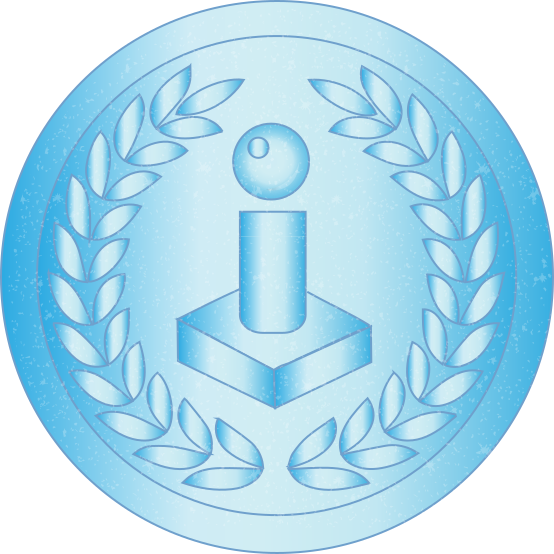
Blip Score: Above are the six tiers of the Blip Score badge: transparent, bronze, silver, gold, onyx, and diamond. These are the same six tiers that each of the six badges have, and each tier requires a different Blip Score threshold to be attained, with the exception of the diamond tier. More on that further down. Blip Score is the site's main statistic, which factors the rarity scores and completion multipliers of achievements.
The first five tiers have the following score requirements:
<25000  |
>25000 |
>100000 |
>250000 |
>500000 |

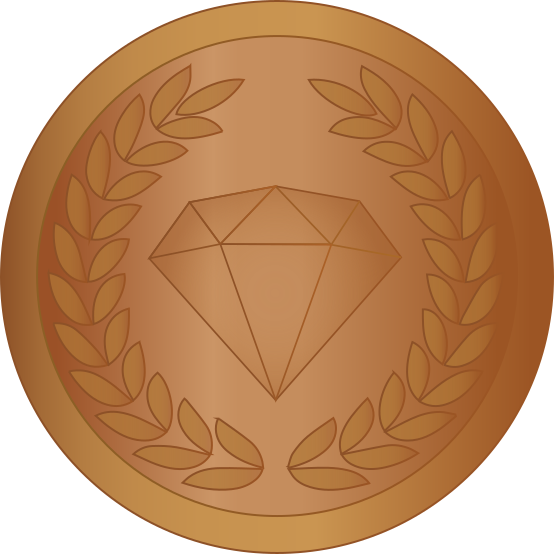

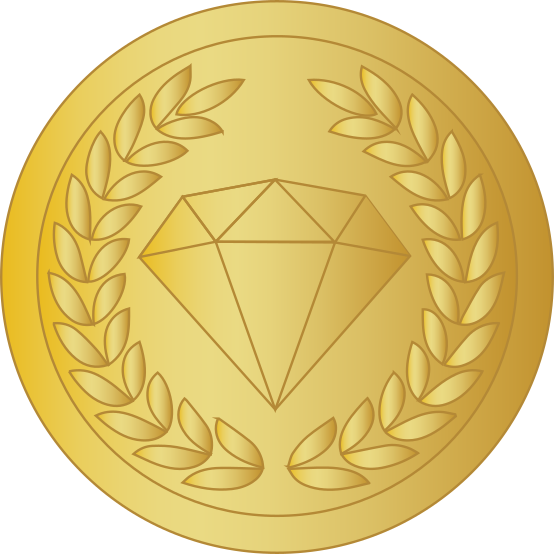


Rarity Score: Above are the six tiers of the Rarity Score badge. Rarity Score is Blip Score, without the completion multipliers. This represents the pure summative difficulty of all achievements you have unlocked.
The first five tiers have the following score requirements:
<2500  |
>2500 |
>7500 |
>15000 |
>30000 |

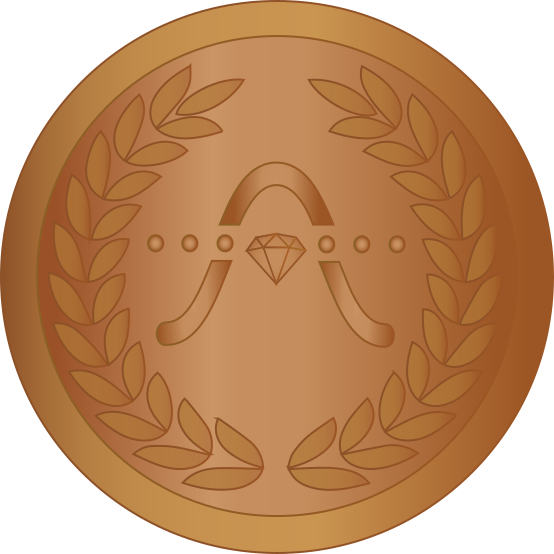


Average Rarity: Above are the six tiers of the Average Rarity badge. This represents the rarity of your average unlock, or in other words, is your total rarity divided by your total number of unlocks.
The first five tiers have the following score requirements:
<1.00  |
>1.00 |
>2.00 |
>3.00 |
>4.00 |





Total Unlocks: Above are the six tiers of the Total Unlocks badge. This represents your summative achievement count across all ecosystems.
The first five tiers have the following score requirements:
<500  |
>500 |
>1000 |
>5000 |
>10000 |





Game Completions Above are the six tiers of the Game Completions badge. This represents the total number of games that you have fully completed (all achievements unlocked). This will depend on your DLC settings. If your setting is set to 'All DLC', then you will need to complete the base game, plus all DLC packs to get a completion. 'Started DLC' will require you to complete the base game, plus all DLC packs that you start (unlock one achievement in). 'Just Base Game' will require you to complete just the base game. All player badge tiers that you see on site will depend on your DLC setting, so this badge in particular may appear as a different tier for you than it does for someone else.
The first five tiers have the following score requirements:
<25  |
>25 |
>100 |
>250 |
>500 |


Completion Percentage Above are the six tiers of the Completion Percentage badge. This represents the total number of unlocks you have, out of the total number of possible unlocks you can obtain in your started games. Like completions, this will depend on your DLC settings. If your setting is set to 'All DLC', possible unlocks will include achievements in all DLC packs. 'Started DLC' will include all achievements in DLC packs you have started (unlocked one achievement in). 'Just Base Game' will only include the achievements in the base game. All player badge tiers that you see on site will depend on your DLC setting, so this badge in particular may appear as a different tier for you than it does for someone else. Unobtainable achievements are not considered possible unlocks, and thus do not count towards this stat. Discontinued achievements do count, as it would be unfair to players who unlocked them otherwise.
The first five tiers have the following score requirements:
| <50% | >50% | >70% | >85% | >99% |
Diamond Tiers: Diamond tier badges are special, in that they can't be reached by simply grinding out one stat until you get there. To earn diamond badges, you must reach the onyx tier for all six badges, after which all six of your badges will be upgraded to diamond. This is the highest tier available, and is incredibly difficult to achieve.
Some of the badges, namely total unlocks, average rarity, and completion percentage can be cheesed incredibly easily. Utilizing spam games on Steam, one can get an onyx unlocks badge in a day. Unlocking one difficult achievement, then never playing anything else, can get you the onyx average rarity badge. Completing one game and then never starting another can get you the onyx completion percentage badge. However, it is impossible to cheese all six badges, as naturally, cheesing the unlocks will doom your chances at an onyx average rarity badge, while playing just one game or unlocking just one achievement will make it impossible to attain onyx badges in Blip score, rarity score, total unlocks, or game completions. Diamond acts as an identifier for those who put the time in, and attained their six onyx badges without any cheese methods. Players who accomplish this deserve the recognition, and any player who reaches the diamond tier with the 'All DLC' setting will be inducted permanently into the Blip Hall of Fame.